Physical Address
304 North Cardinal St.
Dorchester Center, MA 02124
Physical Address
304 North Cardinal St.
Dorchester Center, MA 02124

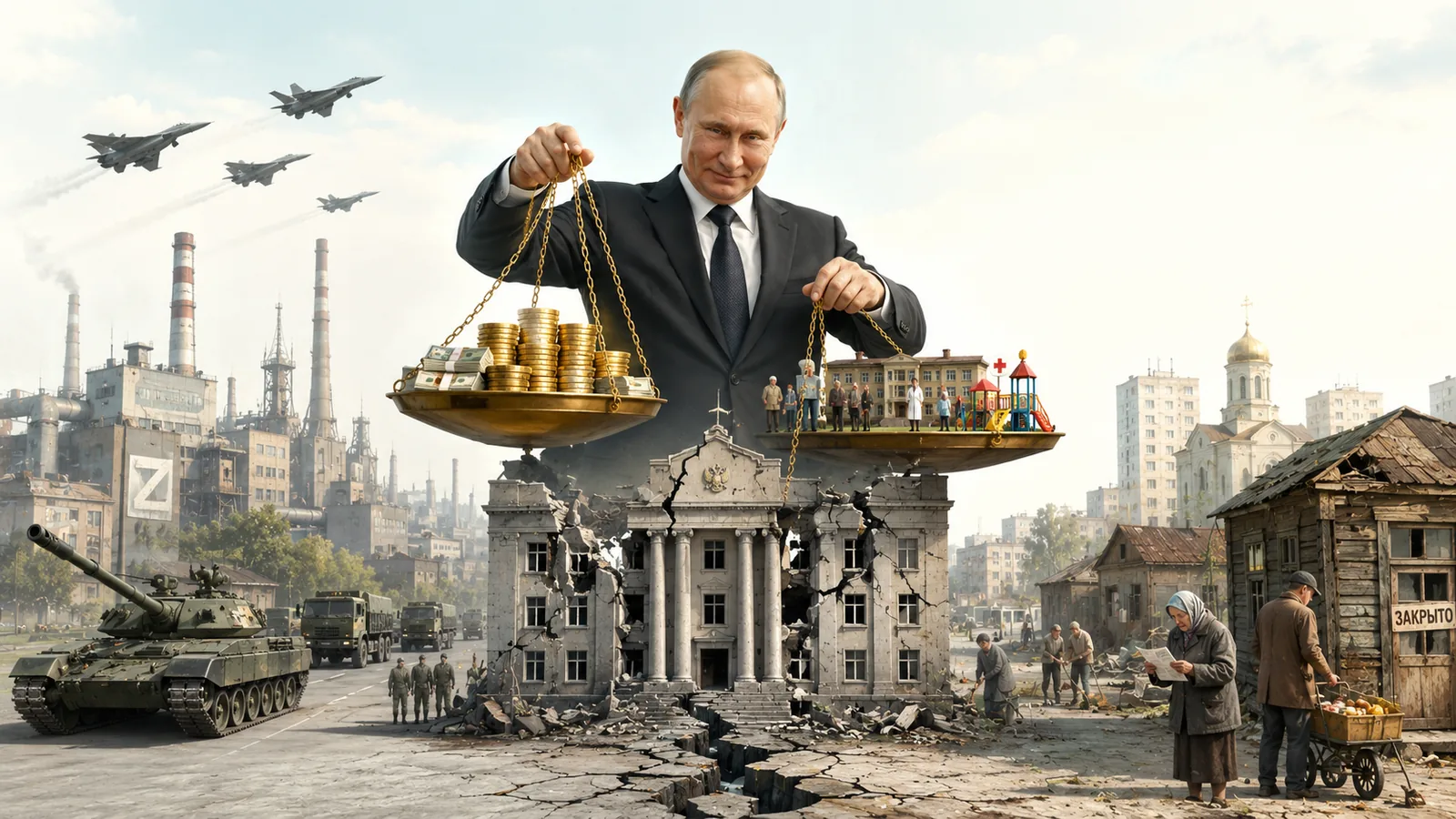
The regime keeps political control, but the everyday state is deteriorating: budgets, police, regions and property rules are all under strain.
On June 10, 2026, the Russian parliament approved a rule that allows the government to quickly change spending and borrowing parameters without the previous public procedure for amending the budget. Formally, this is a technical change. In fact, it is a symptom of a new stage of the war economy: the state no longer lacks not only money, but also public budgetary predictability. According to Reuters, in the first five months of 2026, the federal budget deficit has already reached 2.6% of GDP, against the annual target of 1.6%; The new rules give the cabinet the ability to raise spending and debt faster, and changes to debt and spending plans no longer have to be published in the same way.
This is a good entry into understanding Russia’s internal landscape in mid-2026. Vladimir Putin’s regime does not look like a system on the verge of immediate collapse. But it no longer resembles the pre-war authoritarian vertical, where stability was bought by rising incomes, guided policies and the promise of normality. After four years of full-scale war against Ukraine, stability has become more expensive: it has to be paid for with military payments, budgetary opacity, police depletion, property redistribution and constant pressure on the regions.
The main internal formula of wartime Russia is this: the regime retains political control, but loses the quality of an everyday state. It is strong where it is necessary to suppress, seize and distribute. It weakens where normal police, predictable property rules, regional budgets, a civilian economy and business trust are needed.
Formally, the Russian government can show controllability: plan expenses, promise to maintain the deficit, talk about stabilization. But recent budget decisions show otherwise. If the state needs mechanisms that allow it to change spending and borrowing without a long public procedure, then the previous budget framework can no longer cope with the wartime pace.
Reuters points out that the new changes allow the government to borrow beyond limits set by budget law and increase spending; Previously, this required budget amendments and parliamentary hearings. The Ministry of Finance attributed the increase in the deficit to advance payments on government contracts, and Reuters itself attributes the deterioration in the budget position to military spending and the need to increase VAT.
This changes the optics to the stated reduction in national defense spending in 2026. A nominal decline in the defense line does not necessarily mean a real cooling of the war. The war can be financed through advances, other items, regional obligations, tax changes and non-public adjustments. For a Bloomberg-level analysis, it is not just the “defense” indicator that is important here, but the entire circuit: the federal deficit, regional debts, VAT, classified items and extra-budgetary burden.
The regional level looks even weaker. According to Reuters, Finance Minister Anton Siluanov warned that the total regional budget deficit in 2026 will grow by 27%, to 1.9 trillion rubles. The reasons include falling income tax revenues, rising social spending and war-related expenses, including payments to volunteers and their families. Regional debt to income rose to 19% in 2025, and up to 20 regions were described as problematic.
This does not mean that the regions are ready for open rebellion. On the contrary: the Russian vertical is built in such a way that the region would rather cut investments, medicine, infrastructure and municipal spending than openly refuse to fulfill the military or political obligations of the center. But this means something else: federal resilience is bought at the expense of regional exhaustion.
Decree of the President of the Russian Federation No. 644 of July 31, 2024 established a federal payment of 400 thousand rubles for those entering into a contract, and regions were recommended to establish their own payments of at least 400 thousand rubles at the expense of the subject. Then Executive Order No. 1111 made the federal payment indefinite from January 1, 2025: the previous limitation on the period until December 31, 2024 was removed.
This design became more than just a military recruiting mechanism. It changed the domestic labor market. In poor regions, a contract with the army became a way to make a sharp social leap. For a family in a depressed city, this could mean paying off debt, buying a car, making a down payment on a home, or an immediate increase in consumption. But for the state this has a downside: the Ministry of Internal Affairs, municipal services, civil departments, the construction sector and ordinary business begin to compete not with the normal market, but with the military price of a person.
The most striking symptom is the Interior Ministry. On February 19, 2026, Interior Minister Vladimir Kolokoltsev said in the State Duma that in 2025, 80 thousand employees left the Interior Ministry bodies – almost 40% more than joined the service. The number of vacancies reached 212 thousand. In patrol police, the shortage was 40%; in criminal investigation, about 30%; in investigations, 27%; among district police officers – more than a quarter. In 41 regions, the shortage exceeded 25% of personnel. Kolokoltsev named low wages, high workload and housing problems among the reasons.
This is one of the key facts of the entire internal picture. Russia remains strong in political suppression, but its everyday police fabric is sagging. The FSB, Rosgvardia, Center “E”, the prosecutor’s office and the courts can remain resource-protected. But the district police officer, patrol, inquiry, criminal investigation, primary response to domestic conflicts, thefts and local violence are another level of the state. It is he who is washed away.
Putin’s reaction was revealing. On March 4, 2026, at the board of the Ministry of Internal Affairs, he stated that war veterans need to be more actively involved in the structures of the Ministry of Internal Affairs. This does not look like a long-term personnel reform, but like an attempt to fill the hole with an available, loyal resource. A veteran with combat experience can strengthen the security component of a patrol, but he does not automatically become an investigator, operative, precinct or immigration control specialist.
Therefore, it is more accurate to speak not about the “militarization of the Ministry of Internal Affairs” as a conscious ideological program, but about reactive militarization due to personnel failure. This is an important difference. In the first case, the regime intensifies. In the second, he patches a hole and reduces the professional quality of the state at ground level.
It is easy to build a spectacular but incorrect picture around the topic of private security companies: they say that Russia is moving towards the feudalization of security, where businesses and regions receive their own private armies. The data does not yet support this version. Russian private security organizations remain a licensed and controlled sector, dependent on Rosgvardia. They do not compete with the FSB, FSO or Rosgvardia and do not create independent regional power sovereignty.
But a narrower and more important conclusion is confirmed: the state really shifts part of the facility and infrastructure security to the private sector. On March 23, 2026, Putin signed a law allowing certain specialized private security companies to receive military small arms from Rosgvardia to protect protected facilities from drones. Interfax clarified that this applies to private security companies established by fuel and energy sector entities, strategic enterprises or strategic joint-stock companies, and weapons are provided temporarily and for the purpose of protecting against UAVs.
Context is important: the head of the State Duma Security Committee, Vasily Piskarev, spoke about more than 920 UAV attacks on fuel and energy infrastructure facilities since the beginning of 2024 and noted that more than 80% of fuel and energy infrastructure facilities are protected by private security organizations. That is, private security companies do not receive political autonomy, but a new function in protecting infrastructure, which the state apparatus cannot completely close on its own.
This is not feudalization. This is outsourcing of routine and facility security while maintaining the center’s monopoly on strategic violence. But the very fact of such outsourcing shows: a military state concentrates power resources on the front, political control and key facilities, and everyday security is increasingly decided by surrogates.
The second big pillar of internal stability is fear of property. In 2025, nationalization became one of the main economic trends in Russia. Forbes, citing the NSP law firm, wrote that over the year, assets worth 3.12 trillion rubles went to the treasury – 4.5 times more than in 2024. In total, since 2022, assets worth approximately 6.5 trillion rubles have been transferred to the state. Among the cases, Forbes named Dmitry Kamenshchik’s Domodedovo, Konstantin Strukov’s Yuzhuralzoloto and Denis Shtengelov’s KDV Group; the grounds ranged from strategic status and foreign connections to corruption and “extremist” charges.
This is not just a redistribution of property. This is a political mechanism. If a major owner sees that an asset can be seized through a history of privatization, a corruption track, foreign control or an “extremist” basis, he does not build a coalition against the Kremlin. He is looking for individual protection. He shows loyalty. He does not know what legal pretext may be applied to him tomorrow.
In May-June 2026, the state tried to give business a formal signal of stabilization: the State Duma adopted a law on a 10-year statute of limitations in privatization cases. But a key detail sharply limits the sedative effect. According to Interfax, seizure processes for anti-corruption and anti-extremist claims will not be affected by the new 10-year period.
The legal logic is also confirmed by legal analysis: “Advokatskaya Gazeta” indicated that the Constitutional Court in Resolution No. 49-P/2024 actually removed anti-corruption requirements for the seizure of property from the usual logic of the statute of limitations, and the new law does not affect seizures on anti-corruption and anti-extremist grounds.
Therefore, the law on a 10-year period is not a full guarantee for large capital. Rather, this is an attempt to calm down medium-sized and systemic businesses without taking away from the Prosecutor General’s Office the main instrument of pressure on large assets. For elites, this creates not confidence, but a more subtle signal: the rules may be softer for those who have no political or resource interest, but remain harsh for those whose assets are needed by the state or whose loyalty is in doubt.
The regional problem in wartime Russia is often incorrectly described as a future revolt of the subjects. The more likely trajectory is not rebellion, but burnout.
The regions bear part of the costs associated with the war: payments to contract soldiers, assistance to families, social obligations, infrastructure burdens, and security costs. At the same time, their income base is weakening. Reuters wrote that the fall in income taxes was a major factor in regional deficits; Company profits fell almost 30% year-on-year in January, the latest available data, and profit taxes could account for up to a third of regional budget revenues.
This is especially painful for donor regions and industrial actors: they are used to having their own revenue base, but now face falling corporate profits, high rates, military costs and the need to compete for people. Against this background, subsidized regions turn out to be even weaker: they can formally support the federal line, but in fact they will cut civil spending, postpone projects, build up debts and ask for budget loans.
Open sabotage is unlikely. The deprivatization of big business also acts as a disciplinary mechanism for regional elites: every governor and the business associated with him understands that a conflict with the center can translate into legal and property risk. But the absence of rebellion does not mean the health of the system. This means that the conflict is reduced to delays, formalism, reduction in the quality of services and invisible exhaustion.
Russian society after 2022 is held back not only by propaganda. It is held in place by fear, payouts and the lack of an organizational protest infrastructure.
In March 2022, Russia introduced criminal penalties of up to 15 years for spreading “fakes” about the army. This became the basis of military censorship and dramatically increased the cost of public dissent.
After the death of Alexei Navalny in the colony on February 16, 2024, the last national symbol of legal or semi-legal opposition mobilization within the country disappeared. This did not eliminate discontent, but it did deprive it of its center of gravity. Yevgeny Prigozhin’s rebellion in June 2023 showed that an autonomous armed force within the system could challenge military leadership. But subsequent events showed something else: without the support of key elites and without a stable political structure, such a challenge does not turn into a transfer of power. The deal that ended the mutiny included Prigozhin leaving for Belarus and options for Wagner fighters; history itself has become a lesson for the Kremlin about the need to destroy autonomous power centers before they become political.
Therefore, a mass protest in 2026 looks like a weak scenario. Not because there is no dissatisfaction. But because discontent is fragmented: some receive military payments, others are afraid of mobilization, others are tired of war, others have emigrated, others have adapted to silence. Without an elite split, a major military shock, or a budget collapse, this mass of irritation does not turn into organized action.
The main threat to Putin is not just one crisis. The Russian system knows how to isolate single crises. The personnel failure of the Ministry of Internal Affairs does not become a protest. Regional deficits do not become federal rebellions. Asset seizure does not become a business conspiracy. Society’s fatigue does not become a movement.
The danger arises when crises overlap: military failure, severe budgetary stress, inability to maintain payments, elite panic over the redistribution of property and the failure of repressive logistics. At such a moment, the elites may begin to look not for democratization, but for safe transit: guarantees for the security forces, families, large beneficiaries of the war and groups managing financial flows.
For now, the base scenario is controlled inertia. Putin remains in control. The war continues or becomes protracted. The elites are atomized. The regions are financially burning out. The Ministry of Internal Affairs is deteriorating at the grassroots level. But the political repressive circuit remains working.
The second scenario is controlled transit within the system. It is possible not as democratization, but as a hardware operation with Putin’s biological, medical or political restrictions. In this scenario, the key will not be society, but an agreement between security and property groups.
The third scenario is shock destabilization. Its likelihood increases if front-line failure, budgetary pressure, disruption of payments and elite fear of further redistribution of property come together simultaneously. The budget deficit itself will not bring down the regime. The Interior Ministry crisis itself will not bring down the regime. The redistribution of assets alone will not bring down the regime. But together they can create a moment when the system begins to save itself without the former figure of the arbiter.
Russia in mid-2026 is not a state on the verge of immediate collapse. This is a state that has learned to maintain political stability at the cost of degradation of its own institutions.
The Putin system is strong in suppression, redistribution and intimidation. She knows how to buy loyalty, seize assets, suppress public policy and shift costs to the regions. But it weakens where normal government work is needed: local policing, the civilian economy, regional finance, business confidence, predictable rules and professional governance.
That is why the main question is not whether the regime will collapse tomorrow. The main question is how much longer he will be able to exchange the quality of the state for maintaining power. The longer the war continues, the more Russia becomes a system where the political center remains solid, while everything around it gradually loses strength.
VISIONARY stays independent through reader support.
 Support the newsroom